
This content is for educational purposes only and does not constitute medical advice, diagnosis, or treatment. For concerns related to your baby’s health, development, or sleep, or your own physical or mental wellbeing, always consult a qualified healthcare provider.
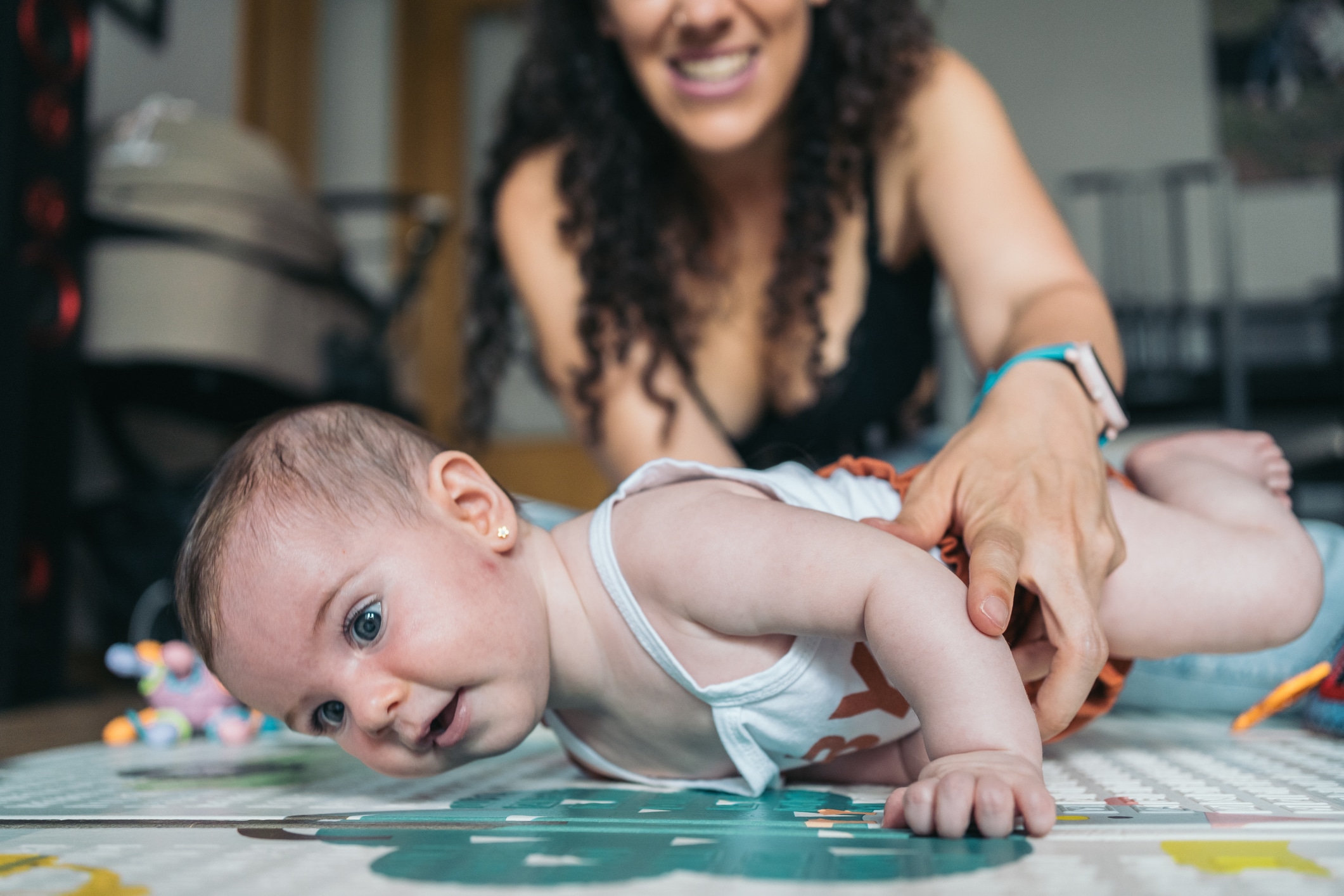
Between 4 and 6 months, tummy time stops being just a task on a checklist and starts becoming something your baby actively participates in. The strength they have been quietly building since birth is now showing up in real, visible ways: heads are lifting higher, arms are pushing up, and the first rolls are beginning to emerge. This post breaks down what is actually happening in your baby’s body during this window, what to watch for, and how to support the process.
What tummy time looks like at 4 months
By 4 months, most babies can push up onto their elbows and forearms during tummy time, holding their head steady and maintaining a centered position thanks to increased neck and shoulder strength.¹ You may also start to see them reach for toys while on their belly, which is a sign that they have enough stability in their trunk to free up one arm for exploration.
The American Academy of Pediatrics (AAP) recommends at least 15 to 30 minutes of total tummy time per day by 7 weeks of age, increasing from there.²ˑ³ International guidelines recommend at least 30 minutes per day for infants who are not yet mobile.⁴ Research shows a dose-response relationship: more tummy time is associated with better developmental outcomes, and the optimal amount appears to increase with age.⁵ By 4 to 6 months, many families find their babies are naturally spending longer stretches on their bellies as tolerance and preference grow. If your baby still resists being on their belly, a rolled towel under their chest or a tummy time wedge can help reduce the effort required and make the position more tolerable while they continue building strength.
How rolling actually develops
Rolling is not a single movement that appears out of nowhere. It is built on a sequence of smaller skills that develop over weeks. Many babies begin rolling from tummy to back first, often between 4 and 6 months, because a small shift in gravity can be enough to tip them over once the arms and head are strong enough to initiate the movement.³ One study found that about 48% of infants were rolling by 4 months, with 78% rolling by 5 months and nearly all by 6 months.⁶
Rolling from back to tummy tends to come a bit later for many babies because it requires more complex coordination: rocking the pelvis, arching the back, and twisting the legs in sequence. That said, the order is not universal. Some babies roll from back to tummy first, and research has shown that the sequence can vary across populations and cultures.⁷ You will often see a baby rocking side to side, reaching for their feet, and shifting weight from hip to hip in the weeks before a full roll appears. Those movements are not random. They are the building blocks.
This is why tummy time matters so much during this window. It is not just about head control. A systematic review found that tummy time was positively associated with gross motor and total development, including the ability to roll.⁸ It is about building the foundational core strength and weight-shifting ability that makes rolling possible.
How to support rolling and tummy time at 4 to 6 months
Place toys just out of reach.
During tummy time, placing a toy slightly to one side encourages your baby to shift their weight, reach, and begin rotating their trunk. This weight-shifting is one of the key precursors to rolling. Use high-contrast or musical toys to hold their attention long enough to practice.
Encourage reaching for feet. 
When your baby is on their back, encouraging them to reach for their feet is a meaningful core-strengthening activity. This kind of active core engagement helps build the strength required for rolling from back to tummy. You can place toys on their feet to make the target more visually interesting.
Try side-lying play.
Placing your baby on their side with a rolled blanket at their back for support is a great bridge position between back-lying and tummy time. It exposes them to a new orientation, encourages reaching across the body, and helps them practice the weight-shifting that underlies rolling. Always supervise this position closely.
Keep floor time unstructured.
Not all floor time needs to be formal tummy time. Carriers, bouncers, and other confining equipment are convenient, but they do not replace time on the floor. Research shows that higher amounts of restrained time are associated with later acquisition of motor milestones, while higher tummy time is consistently associated with more advanced gross motor development.⁹ At 4 to 6 months, free floor play is some of the most valuable time in your baby’s day.
By 6 months: what to expect
Around 6 months, tummy time often blends into free floor play. Babies who have built a strong foundation are rolling, pivoting in circles, and reaching in multiple directions during belly time.⁸ At this stage, many babies can push up with straight arms when on their tummy and are beginning to lean on their hands to support themselves when sitting.¹ Core strength that has been developing since the early weeks of tummy time is what makes all of this possible.
At the 6-month well visit, your pediatrician will assess head control, rolling, and overall motor development. If your baby is not yet rolling in either direction, still struggles with head control, or consistently resists tummy time, bring it up at that visit. A referral to a pediatric physical or occupational therapist can help identify whether anything needs support and give you specific exercises to work on at home.¹⁰
Signs worth mentioning to your pediatrician or a pediatric PT or OT
The following signs at or around 4 to 6 months are worth discussing with a provider:¹⁰ˑ¹¹
- Not rolling in either direction by 6 months
- Reaching consistently with only one hand
- Stiff or very floppy muscle tone that seems pronounced or asymmetrical
- No improvement in head control since the early months
- Strong resistance to tummy time that does not ease with time or position changes
- Preferring to keep the head turned to one side (possible torticollis — early identification and physical therapy lead to the best outcomes)¹²
- Motor milestones appearing in an unusual sequence (for example, rolling before being able to prop on elbows)¹¹
If any of these sound familiar, early is always better. Pediatric physical and occupational therapists work with babies from birth and can assess whether what you are seeing is within the expected range or worth addressing with targeted support. For torticollis specifically, physical therapy initiated before 1 month of age yields a 98% success rate, while outcomes decrease significantly when treatment is delayed beyond 6 months.¹²
This content is for educational purposes only and does not constitute medical advice, diagnosis, or treatment. For concerns related to your baby’s health, development, or sleep, or your own physical or mental wellbeing, always consult a qualified healthcare provider.
Every baby is different. Browse The Baby Collective directory to find the right specialist for your family.
Every baby is different. Browse The Baby Collective directory to find the right specialist for your family.
References
- Zubler JM, Wiggins LD, Macias MM, et al. Evidence-Informed Milestones for Developmental Surveillance Tools. Pediatrics. 2022;149(3):e2021052138.
- Moon RY, Carlin RF, Hand I. Sleep-Related Infant Deaths: Updated 2022 Recommendations for Reducing Infant Deaths in the Sleep Environment. Pediatrics. 2022;150(1):e2022057990.
- Moon RY, Carlin RF, Hand I. Evidence Base for 2022 Updated Recommendations for a Safe Infant Sleeping Environment to Reduce the Risk of Sleep-Related Infant Deaths. Pediatrics. 2022;150(1):e2022057991.
- Hewitt L, Stanley RM, Cliff D, Okely AD. Objective Measurement of Tummy Time in Infants (0-6 Months): A Validation Study. PLoS One. 2019;14(2):e0210977.
- Zhang Z, Predy M, Hesketh KD, Pritchard L, Carson V. Characteristics of Tummy Time and Dose-Response Relationships With Development in Infants. European Journal of Pediatrics. 2023;182(1):113-121.
- Chang CL, Hung KL, Yang YC, Ho CS, Chiu NC. Corpus Callosum and Motor Development in Healthy Term Infants. Pediatric Neurology. 2015;52(2):192-197.
- Nelson EA, Yu LM, Wong D, Wong HY, Yim L. Rolling Over in Infants: Age, Ethnicity, and Cultural Differences. Developmental Medicine and Child Neurology. 2004;46(10):706-709.
- Hewitt L, Kerr E, Stanley RM, Okely AD. Tummy Time and Infant Health Outcomes: A Systematic Review. Pediatrics. 2020;145(6):e20192168.
- Carson V, Zhang Z, Predy M, Pritchard L, Hesketh KD. Longitudinal Associations Between Infant Movement Behaviours and Development. International Journal of Behavioral Nutrition and Physical Activity. 2022;19(1):10.
- Noritz GH, Murphy NA. Motor Delays: Early Identification and Evaluation. Pediatrics. 2013;131(6):e2016-27.
- Davis BE, Leppert MO, German K, Lehmann CU, Adams-Chapman I. Primary Care Framework to Monitor Preterm Infants for Neurodevelopmental Outcomes in Early Childhood. Pediatrics. 2023;152(1):e2023062511.
- Nichter S. A Clinical Algorithm for Early Identification and Intervention of Cervical Muscular Torticollis. Clinical Pediatrics. 2016;55(6):532-536.