
This content is for educational purposes only and does not constitute medical advice, diagnosis, or treatment. For concerns related to your baby’s health, development, or sleep, or your own physical or mental wellbeing, always consult a qualified healthcare provider.
A judgment-free, research-backed guide to your safest sleep options — and choosing what actually works for your family.
Few topics in parenting generate as much confusion, and guilt, as where your baby should sleep. Walk into any new-parent group and you’ll hear passionate opinions on both sides. Some swear by bed sharing. Others wouldn’t dream of it. And most are just exhausted, trying to figure out what’s safest and what’s realistic.
Here’s the good news: the science is actually clearer than the internet makes it seem. And once you understand a few key concepts, you can make an informed decision that works for your family. Not your neighbor’s family. Not the family in the parenting forum. Yours.
First, Let’s Get the Words Right
One of the biggest sources of confusion is that people use “co-sleeping” and “bed sharing” interchangeably, but they’re not the same thing.¹
– Co-sleeping means sleeping in close proximity to your baby, close enough to see, hear, or touch each other. This can mean sharing a bed, or it can mean having your baby in a bassinet right next to you.
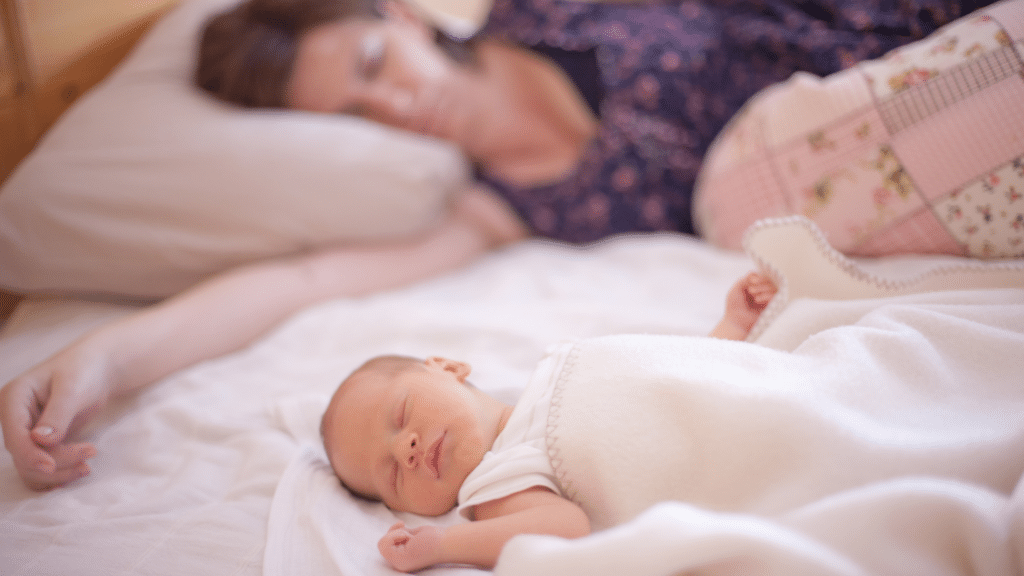
– Bed sharing (also called surface sharing) is a specific type of co-sleeping where the baby is on the same surface as another person, whether that’s a bed, a couch, or a chair.
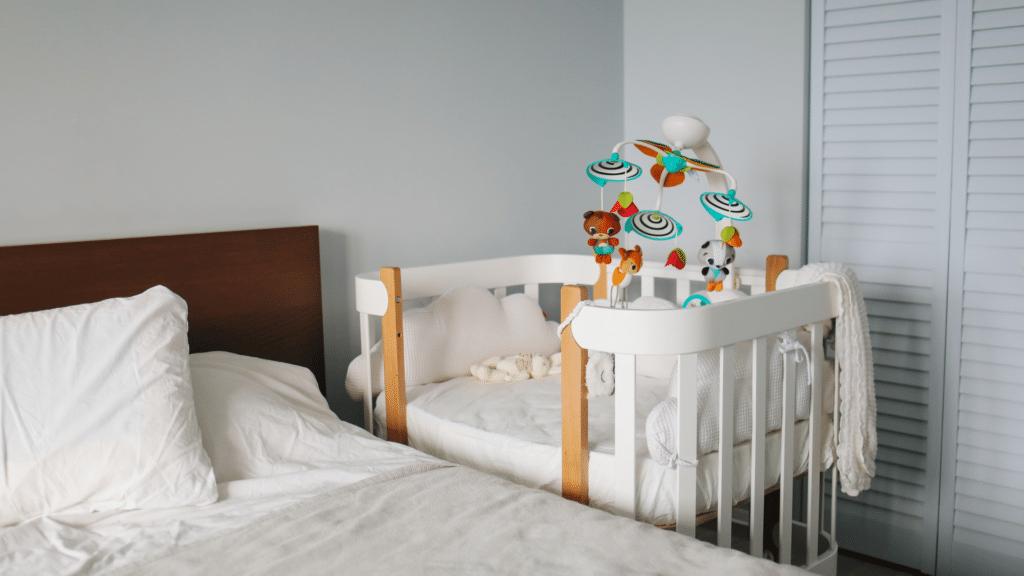
– Room sharing means the baby sleeps in your room but on their own separate surface, like a crib or bassinet.
This distinction matters enormously, because the safety data for room sharing and bed sharing are very different.
What Does the Research Actually Say?
Multiple large studies, systematic reviews, and medical organizations (including the American Academy of Pediatrics, which updated its guidelines in 2022) point to the same core finding: room sharing without bed sharing, ideally for at least the first 6 months, is the safest arrangement.¹ ² ³
Why? Because room sharing on a separate surface has been shown to reduce the risk of SIDS by as much as 50%.¹ ³ It keeps your baby close enough to feed, comfort, and monitor, without the risks that come with sharing a sleep surface.
On bed sharing specifically, the research has consistently shown increased risk. That’s worth taking seriously. But it’s also worth understanding that risk is not a single number, and not all bed-sharing situations are equally dangerous.
Understanding the Risk: It’s Not All-or-Nothing
One of the most useful things to come out of recent research is a clearer picture of how risk varies depending on the circumstances.² Not all bed-sharing situations carry the same level of danger:
More than 10 times the baseline risk:
– Bed sharing with someone impaired by alcohol, drugs, or sedating medications
– Bed sharing with a smoker (or if the pregnant parent smoked during pregnancy)
– Bed sharing on a soft surface like a couch, waterbed, or armchair
5 to 10 times the baseline risk:
– Infants younger than 4 months, even if breastfed and neither parent smokes
– Bed sharing with anyone who is not the infant’s parent (siblings, other caregivers)
2 to 5 times the baseline risk:
– Preterm or low birth weight infants
– Bed sharing with soft bedding like pillows or blankets
This risk spectrum is important because it helps you understand which situations are most dangerous and which factors you can control.² If you ever find yourself in a situation where bed sharing happens (and it does, more on that below), knowing these risk factors can help you minimize harm.
Why Do Parents Bed Share?
Parents bed share for real, understandable reasons, and those reasons deserve respect, not judgment:¹ ⁴
– It can make breastfeeding easier and more frequent
– Cultural and family traditions
– Bonding and closeness
– Comforting a fussy baby
– A belief that it’s safer to keep baby close
– Economic necessity, because not every family has space for a separate crib
In many parts of the world, bed sharing is the norm, not the exception.⁴ A Cochrane review noted that for many families globally, bed sharing is not a choice but a practical reality, and that in some cultures it is believed to contribute to longer breastfeeding duration and increased maternal awareness of the infant.⁴
There is also evidence that bed sharing is associated with longer breastfeeding duration and higher rates of exclusive breastfeeding.⁵ Since breastfeeding itself is protective against SIDS, this creates a genuine tension in the recommendations, one that researchers openly acknowledge.
But What About Parental Sleep and Stress?
You may have heard that bed sharing is less stressful for parents, or conversely, that it makes things worse. The research tells a complicated story, and this is a great place to talk about something that matters beyond just sleep: how to read the studies that show up in your social media feed.
Some longitudinal studies have found that mothers who bed share or room share experience more fragmented sleep, more nighttime awakenings, and poorer overall sleep quality compared to mothers whose infants sleep in a separate room.⁶ ⁷ Headlines and social media posts often present findings like these as settled fact: “Study proves cosleeping makes mothers more stressed!” But when you look deeper, it’s not so cut and dry.
Take one widely cited study that found cosleeping was associated with mothers reporting less positive coparenting and being observed as less emotionally available at bedtime. Sounds alarming, right? But here’s what the Instagram post won’t tell you: the mothers in the cosleeping group were significantly more likely to be of higher socioeconomic risk, unemployed, and to have completed fewer years of education. These are factors that are independently and powerfully associated with stress, sleep disruption, and strained family dynamics, regardless of where the baby sleeps.
The study found an association between cosleeping and poorer maternal outcomes, but it cannot establish that cosleeping caused those outcomes. The mothers who were cosleeping were already dealing with more stressors. Was it the cosleeping that made things harder, or was it poverty, lack of support, and systemic disadvantage? The study design simply can’t answer that question.
This is a pattern worth recognizing. Observational studies, which make up the bulk of sleep research (because you can’t ethically randomly assign families to sleep arrangements), can tell us that two things tend to occur together. They cannot tell us that one caused the other. When you see a study shared on social media as proof that cosleeping is harmful (or beneficial), ask yourself: Who was in the study? Were the groups comparable? Could something else explain the results?
This doesn’t mean we throw out all observational research. It means we hold it with appropriate humility and look at the full body of evidence, not just one study stripped of its context.
What About Long-Term Effects on the Baby?
The evidence here is mixed and limited.⁸ Some small studies have suggested that bed sharing may be associated with greater infant self-regulatory behavior, while others have found no differences in attachment, bonding, or sensitive parenting at 18 months.⁸ One study from Brazil found increased odds of psychiatric diagnoses at age 6 among persistent bed sharers, but (again) there were significant sociodemographic differences between groups that make it hard to draw firm conclusions.⁸ Importantly, room sharing without bed sharing for the first 6 months was not associated with any sleep or behavior problems at ages 6 to 8 years.⁸
The Reality: Sometimes It Just Happens
Here’s something that doesn’t get said enough: bed sharing can happen unintentionally (and intentionally), and that’s okay to talk about openly.² Parents fall asleep while feeding. Exhaustion takes over. A fussy baby finally settles in your arms at 3 AM.
Research and clinical experience both tell us the same thing: if you do fall asleep, it is relatively less hazardous (though still not the safest option) to fall asleep with the infant in the adult bed than on a sofa or armchair.² Falling asleep on a couch or recliner with a baby is one of the most dangerous sleep situations, far riskier than an adult bed. Planning for this possibility isn’t giving up. It’s being realistic.
So How Do You Decide What’s Best for Your Family?
There’s no single right answer, but here’s a framework for thinking it through:
1. Start with the safest option. Room sharing with a separate sleep surface (crib, bassinet, or bedside sleeper that meets safety standards) gives you the closeness and convenience of having your baby nearby while reducing SIDS risk by up to 50%.¹ ³ ⁵
2. Know the non-negotiable risk factors. If any of the following apply, bed sharing should be avoided entirely:² ⁹
– Any alcohol or sedating substance use
– Smoking (by either parent, or during pregnancy)
– Soft sleep surfaces (couches, recliners, waterbeds)
– Baby is under 4 months old
– Baby was born preterm or low birth weight
3. Plan for the unplanned. If you’re breastfeeding and think you might fall asleep during a feed, do it in your bed rather than on a couch or chair. Remove pillows, blankets, and soft bedding.
4. Protect the other proven factors. Regardless of where your baby sleeps, these are the evidence-based strategies that reduce SIDS risk:¹ ² ³ ⁹ ¹⁰
– Place your baby on their back to sleep
– Use a firm, flat sleep surface with a fitted sheet, nothing else
– Breastfeed if possible (any amount is protective)
– Offer a pacifier at sleep time
– Keep the room smoke-free
– Avoid overheating and head covering
5. Give yourself grace. Parenting is not a pass/fail exam. The goal is to understand the risks, minimize them as much as possible, and make the best decision you can with the information and resources you have.
The Bottom Line
The safest sleep arrangement for your baby, based on the best evidence we have, is room sharing on a separate surface, a crib or bassinet next to your bed. Bed sharing carries real risks, and those risks increase dramatically with certain factors like alcohol, smoking, soft surfaces, and very young infants.
But families are diverse. Cultural practices matter. Economic realities matter. And exhausted parents deserve honest, nonjudgmental information, not shame, not scare tactics, and not a list of don’ts with no acknowledgment of real life.
Understanding the spectrum of risk empowers you to make safer choices, even in imperfect circumstances. And that’s what good parenting looks like: not perfection, but informed, thoughtful decisions made with love.
—
Resources
1. Moon RY, Carlin RF, Hand I. Evidence Base for 2022 Updated Recommendations for a Safe Infant Sleeping Environment to Reduce the Risk of Sleep-Related Infant Deaths. Pediatrics. 2022;150(1):e2022057744.
2. Moon RY, Carlin RF, Hand I. Sleep-Related Infant Deaths: Updated 2022 Recommendations for Reducing Infant Deaths in the Sleep Environment. Pediatrics. 2022;150(1):e2022057990.
3. Darrow HJ, Carman KA, Wheeler V. Sudden Infant Death Syndrome: Common Questions and Answers. American Family Physician. 2025;111(2):161-168.
4. Das RR, Sankar MJ, Agarwal R. Bed sharing versus no bed sharing for healthy term neonates. Cochrane Database of Systematic Reviews. 2021;4:CD012866.
5. Moon RY, Carlin RF, Hand I. Evidence Base for 2022 Updated Recommendations for a Safe Infant Sleeping Environment to Reduce the Risk of Sleep-Related Infant Deaths. Pediatrics. 2022;150(1):e2022057744. (Section: Infant Sleep Location, Breastfeeding and Bed Sharing)
6. Volkovich E, Bar-Kalifa E, Meiri G, Tikotzky L. Mother-Infant Sleep Patterns and Parental Functioning of Room-Sharing and Solitary-Sleeping Families: A Longitudinal Study From 3 to 18 Months. Sleep. 2018;41(2):zsx207.
7. Volkovich E, Ben-Zion H, Karny D, Meiri G, Tikotzky L. Sleep Patterns of Co-Sleeping and Solitary Sleeping Infants and Mothers: A Longitudinal Study. Sleep Medicine. 2015;16(11):1305-1312.
8. Moon RY, Carlin RF, Hand I. Evidence Base for 2022 Updated Recommendations for a Safe Infant Sleeping Environment to Reduce the Risk of Sleep-Related Infant Deaths. Pediatrics. 2022;150(1):e2022057744. (Section: Infant Sleep Location, Psychological Outcomes)
9. Carlin RF, Moon RY. Risk Factors, Protective Factors, and Current Recommendations to Reduce Sudden Infant Death Syndrome: A Review. JAMA Pediatrics. 2017;171(2):175-180.
10. Moon RY, Carlin RF, Hand I. Evidence Base for 2022 Updated Recommendations for a Safe Infant Sleeping Environment to Reduce the Risk of Sleep-Related Infant Deaths. Pediatrics. 2022;150(1):e2022057744. (Section: Pacifier Use)